
To review a work of art you have to be present
To review a work of art you have to be present. In the now, in the space, in the emotions: lucid, completely awake. I will not pretend my words are objective; they are shaped by my own story, by what I have learned, by what I have read and by what has fooled me. This text is one lie among thousands of truths, like the tales Scheherazade told to keep her head. The reader will forgive my excesses, because this is a declaration of love, one I never confessed, for a canvas so large that it fills a room, a museum, a city and a world.
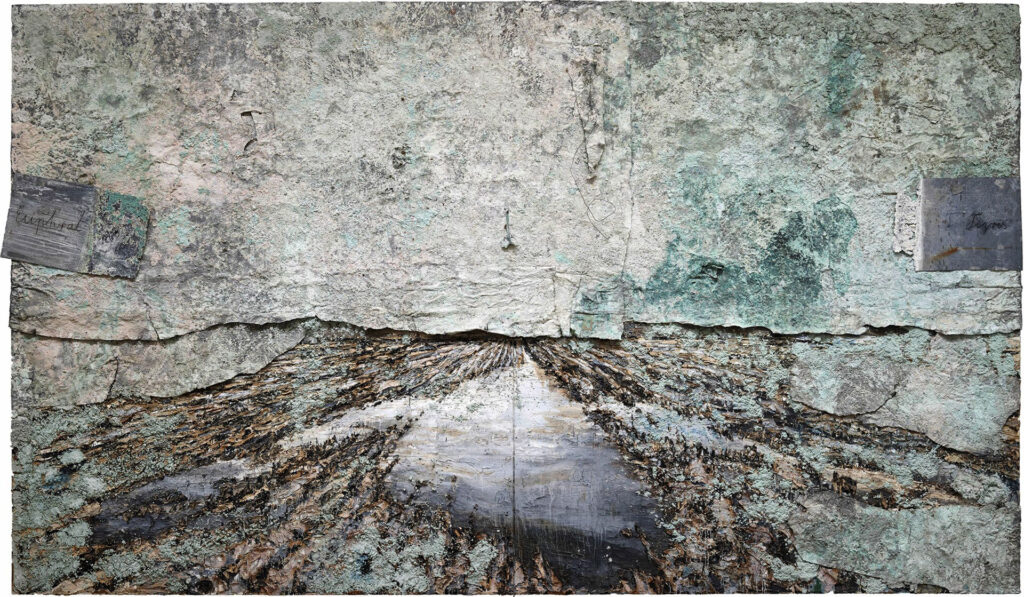
It is Anselm Kiefer’s The Land of the Two Rivers (Zweistromland, 1995), at the Guggenheim Museum Bilbao: more than four metres by seven, with a broken horizon. Lead, zinc oxide, copper and its turquoise rust give it a pale, matte light, beautiful but dim, an air of decadence and ruin, of the ancient and the eternal. Its aura is undeniable: the light reflected by corroded metal, the faint smell of oxide, the grandeur, the attitude in every millimetre. A central composition with vanishing lines divides it into sky and earth, and the heavy, nuanced atmosphere is reflected in the river drawn below, edged by the scratches of a hard land ploughed by the brush, like the bare rocks the tide leaves behind. Through that water the sky enters the earth, and everything becomes more ethereal and mystical. But the sky has no joy in it. It is cold like a post-war winter. It is not the ochre sky that suffocates Goya’s dog, nor the night full of stars of its companion in the room, The Renowned Orders of the Night (1997). It is the dying reflection of what must once have been a fertile river.
Kiefer wrote two words, one at each end, on the overlapping plates: Euphrat and Tigris. The two rivers between which the Sumerians invented writing four thousand years before Christ, a key place for Judaism and Christianity, and an allegory of our endless search to understand existence. Kiefer looks for questions and answers in ancient myth, in the Epic of Gilgamesh, where the king of Uruk passes through every stage of humanity, from savagery to friendship, loss, the search for eternity, which he finds only in the written word and in art, and finally defeat as a mortal who has nevertheless understood what a meaningful life is.
Born in 1945 in the twilight of Germany, Kiefer searches the ashes and rubble of his childhood, and among rust, dust and the wrinkles of time on steel he finds a lost beauty, fragments of Germanic myth, the Nibelungs, Wagner, and the foundations of a nationalism he forces us to look at. Like Joseph Beuys he believes art can transform society, but he gives that commitment a deep mystical sense. Seeing him after writing about Antonio Saura, I recognised the same thing in both: a love of literature, of the written word, an intelligence you can touch, overwhelming and physical, far from anything light or superficial. No age, no government, no propaganda and no marketing can inflate a work like this. It is the work speaking for itself.
In these turbulent times, when the Tigris and the Euphrates are once again silent witnesses of human error, I claim art as the salvation of what is human. Kiefer believed it, Saura believed it, Picasso believed it, and thousands of artists before and after them. Their works are cathedrals of human resistance, where every stroke is an act of courage and every canvas proof that art can lift us above our failures.
Wherever you are, if a work has caught your eye, or you would like my view on a piece you own or are thinking about, write to me. I will be glad to look at it with you.